
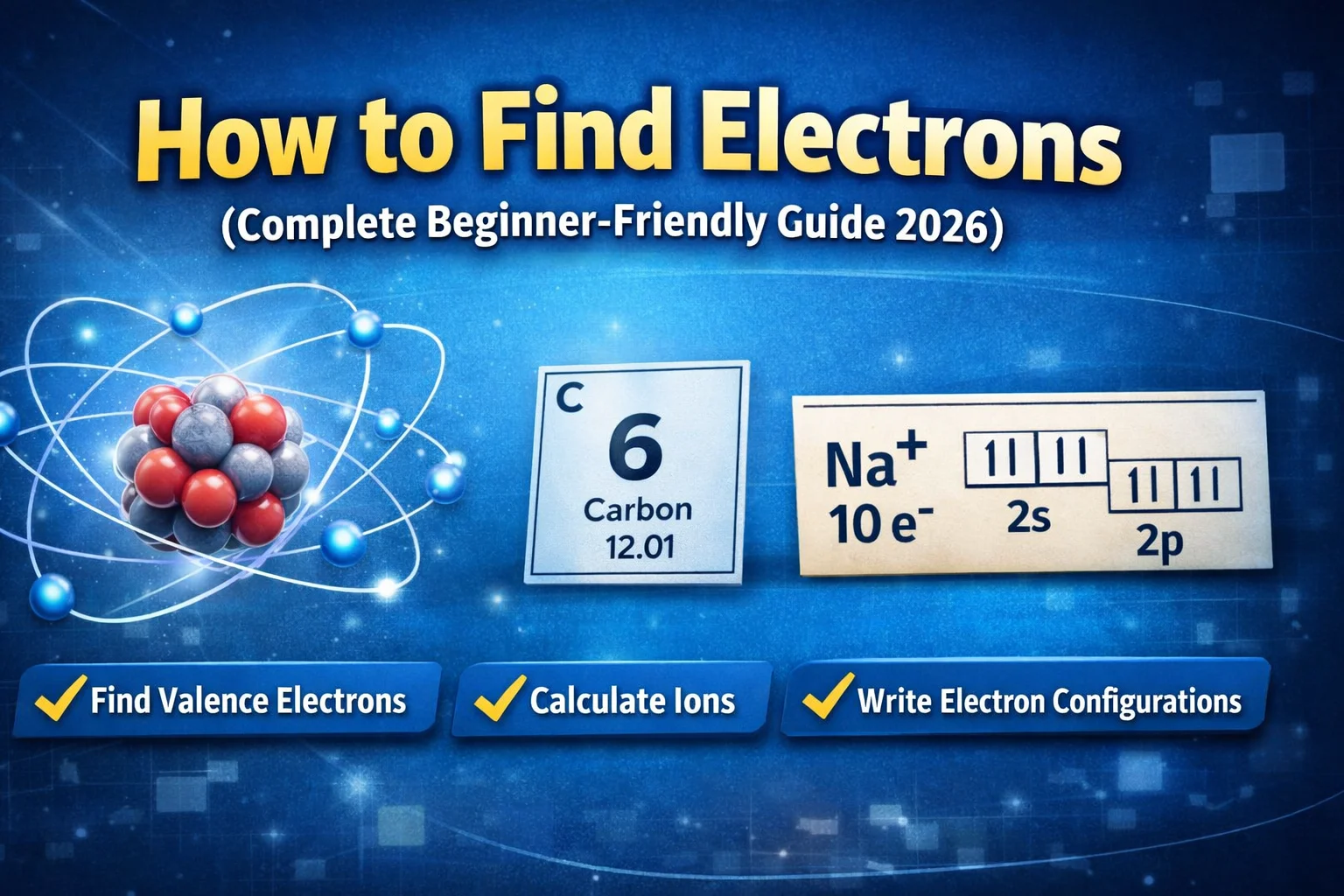
Understanding how to find electrons may sound tricky at first, but it’s actually simple once you break it down. Think of atoms like tiny solar systems. At the center, you have protons and neutrons. Around them, electrons move like planets around the sun. Once you learn a few easy rules, you can quickly figure out how many electrons any element has.
In this guide, I’ll walk you through everything step by step. You’ll learn how to find electrons in an element, how to calculate valence electrons, and even how to write electron configurations. I’ll also share simple tricks that students often use to make this topic easier.
What Are Electrons?
Electrons are very small particles found in every atom. They carry a negative charge. These particles move around the nucleus, which is the center of the atom.
Electrons are important because they control how atoms behave. They decide how elements react and form bonds. For example, the reason oxygen reacts with hydrogen is because of how its electrons are arranged.
If you are learning how to find electrons, always remember this: electrons are linked directly to the atomic number. This is the key idea that makes everything easier.
The Simple Rule to Find Electrons
Here’s the easiest way to understand how to find number of electrons:
In a neutral atom:
Number of electrons = Number of protons = Atomic number
That’s it. No complicated math needed.
Example Table
| Element | Atomic Number | Protons | Electrons |
|---|---|---|---|
| Hydrogen | 1 | 1 | 1 |
| Carbon | 6 | 6 | 6 |
| Oxygen | 8 | 8 | 8 |
| Sodium | 11 | 11 | 11 |
So if someone asks you how to find how many electrons are in an element, just look at the atomic number.
How to Find Electrons in Ions
Things change slightly when atoms gain or lose electrons. These are called ions.
- Positive ion (cation): loses electrons
- Negative ion (anion): gains electrons
Formula:
- Electrons = Atomic number – charge (for positive ions)
- Electrons = Atomic number + charge (for negative ions)
Example Table
| Ion | Atomic Number | Charge | Electrons |
|---|---|---|---|
| Na⁺ | 11 | +1 | 10 |
| Cl⁻ | 17 | -1 | 18 |
| Mg²⁺ | 12 | +2 | 10 |
| O²⁻ | 8 | -2 | 10 |
This is an important step in learning how to find electrons of an element in real-world chemistry.
How to Find Protons, Neutrons, and Electrons
To fully understand atoms, you need all three particles.
- Protons = Atomic number
- Electrons = Atomic number (if neutral)
- Neutrons = Mass number – Atomic number
Example Table
| Element | Atomic Number | Mass Number | Protons | Neutrons | Electrons |
|---|---|---|---|---|---|
| Carbon | 6 | 12 | 6 | 6 | 6 |
| Oxygen | 8 | 16 | 8 | 8 | 8 |
| Sodium | 11 | 23 | 11 | 12 | 11 |
This method helps when learning how to find out protons neutrons and electrons quickly.
How to Find Electrons in an Element Step-by-Step
Let’s break this down into simple steps:
- Find the atomic number on the periodic table
- That number equals protons
- In a neutral atom, electrons = protons
- Adjust if the atom has a charge
Example
For aluminum:
- Atomic number = 13
- Electrons = 13
This simple process is the core of how to find electrons in an element.
How to Find Valence Electrons
Valence electrons are the outermost electrons. They are the most important for chemical reactions.
To find them:
- Look at the group number in the periodic table
- For main group elements:
- Group 1 → 1 valence electron
- Group 2 → 2 valence electrons
- Group 13 → 3 valence electrons
- Group 18 → 8 valence electrons
Example Table
| Element | Group | Valence Electrons |
|---|---|---|
| Lithium | 1 | 1 |
| Carbon | 14 | 4 |
| Oxygen | 16 | 6 |
| Neon | 18 | 8 |
Learning how to find valence electrons helps you understand bonding and reactions.
How to Find Electron Configuration
Electron configuration shows how electrons are arranged in an atom.
Electrons fill energy levels in a specific order:
1s → 2s → 2p → 3s → 3p → 4s → 3d → 4p
Example
For oxygen (8 electrons):
1s² 2s² 2p⁴
This means:
- 2 electrons in 1s
- 2 in 2s
- 4 in 2p
Understanding this is key when learning how to find electron configuration.
Easy Trick to Remember Electron Filling
Here’s a simple tip I used as a student:
Think of it like filling seats in rows. Each row fills before moving to the next.
Also:
- s holds 2 electrons
- p holds 6 electrons
- d holds 10 electrons
This trick makes how to find electrons much easier to remember.
How to Find the Number of Electrons in Real Problems
In exams, questions often mix concepts. You may see:
“Find electrons in Mg²⁺”
Step-by-step:
- Atomic number of Mg = 12
- Charge = +2
- Electrons = 12 – 2 = 10
Practicing these problems improves your understanding of how to find the number of electrons in an element.
Common Mistakes to Avoid
Many students make small mistakes when learning this topic. Here are a few:
- Forgetting to adjust for ions
- Mixing up mass number and atomic number
- Miscounting valence electrons
- Writing electron configurations in the wrong order
Take your time and double-check your steps. This helps you master how to find electrons correctly.
Why Electrons Matter in Chemistry
Electrons are not just numbers. They explain everything in chemistry.
They decide:
- How atoms bond
- Why reactions happen
- What properties elements have
For example, sodium reacts strongly with water because it has one valence electron. It wants to lose it quickly.
So when you learn how to find electrons, you’re also learning how chemistry works.
Real-Life Example to Make It Clear
Think of electrons like keys. Each atom has a certain number of keys. These keys decide which doors (reactions) it can open.
For example:
- Oxygen has 6 valence electrons
- It needs 2 more to be stable
- So it reacts easily with hydrogen
This simple idea helps you remember how to find electrons in an element and why it matters.
Practice Questions Table
| Question | Answer |
|---|---|
| Electrons in Nitrogen | 7 |
| Electrons in Ca²⁺ | 18 |
| Valence electrons in Fluorine | 7 |
| Electron configuration of Neon | 1s² 2s² 2p⁶ |
Try solving these on your own to improve your skills.
FAQs
1. What is the easiest way to learn how to find electrons?
The easiest way is to remember that electrons equal the atomic number in neutral atoms. This rule solves most problems quickly.
2. How do you find electrons in ions?
You adjust based on charge. Subtract electrons for positive ions and add for negative ions.
3. Why are valence electrons important?
They control chemical reactions and bonding. Without them, atoms would not interact.
4. How do I find electron configuration fast?
Follow the filling order and remember s, p, and d capacities. Practice helps a lot.
5. Can electrons be more than protons?
Yes, in negative ions. For example, Cl⁻ has more electrons than protons.
6. What is the difference between electrons and protons?
Electrons are negative and move around the nucleus. Protons are positive and stay inside the nucleus.
Conclusion
By now, you should feel much more confident about how to find electrons in any atom or ion. The key idea is simple: start with the atomic number, and then adjust only if the atom has a charge. From there, you can go deeper by finding valence electrons and understanding electron configuration.
Take it step by step. First, master how to find the number of electrons in an element. Then practice with ions. After that, move on to more advanced topics like electron arrangement. This gradual approach makes learning easier and less confusing.
If you ever feel stuck, go back to the basics. Most problems can be solved using simple rules. With regular practice, you’ll quickly improve and start solving questions with confidence.